Showing posts with label sound design. Show all posts

Friday, 15 April 2022

Imitative Sound Design For Synthesizers...

In a recent thread on the VI-Control forum, Alessandro Arcidiaco asked about resources for learning imitative sound design - making the sounds of acoustic instruments by electronic means (synthesizers et al). Here's my (edited) response:
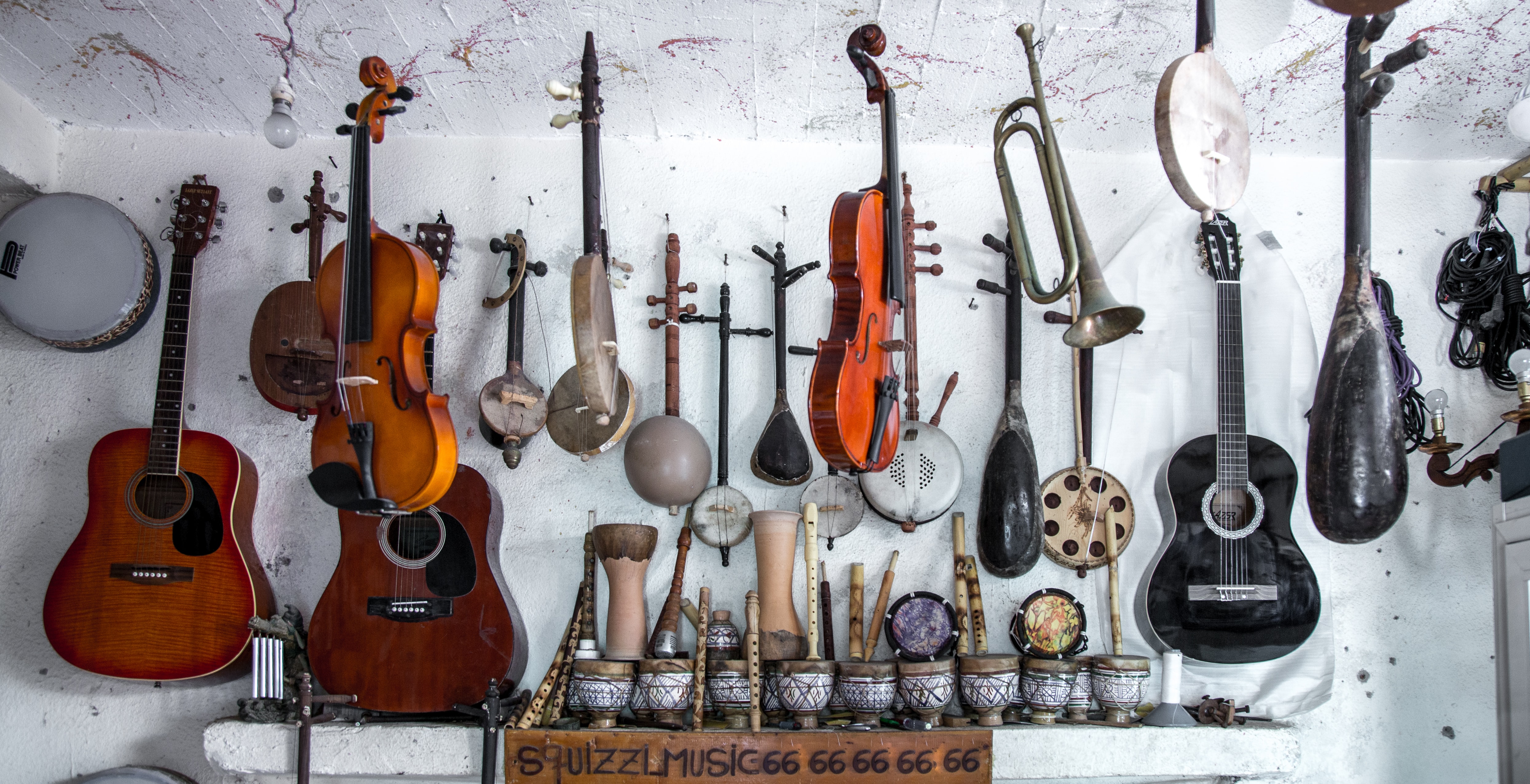
Photo by Karim MANJRA on Unsplash

Most 'how to...' 'synthesizer' articles talk about how to create 'classic' synthesizer sounds, and Gordon Reid's magnum opus 'Synth Secrets' series (in Sound On Sound) covers that in a lot of depth: 

https://www.soundonsound.com/series/synth-secrets-sound-sound 

There are quite a few articles in the series that talk about creating realistic sounds (wind, brass, strings, drums, etc.), often used as an illustration of the uses of specific synthesis techniques. (There are also various books from the end of the 20th Century, assembled from 'Electronic Musician' articles from Jim Aikin, Marc Vail, Craig Anderton et al covering much the same material, again with some coverage of imitative techniques, but I can't recall a specific 'imitative' series... So, my short answer is that I don't know of the 'definitive' answer - but that doesn't mean it doesn't exist!)

https://synthandsoftware.com/author/jimaikin/ (Bio of Jim Aikin)

https://jimaikin.net/ (Jim Aikin's web-site)

http://www.markvail.com/ (Marc Vail's web-site)

https://craiganderton.org/ (Craig Anderton's web-site)

(It is quite interesting to see how a previous generation of 'people who reviewed and wrote about synthesizers' is represented by magazine articles, reviews, books and web-sites, whereas the current  Loopop, Benn Jordan, Starsky Carr, etc. generation are all very active on YouTube...)

You can see this non-specific-ness about imitative synthesis in my 'Practically FM' series (in Sound On Sound magazine many decades ago), which kind of works towards 'imitative', but it tends to show more about how FM can produce synthesised, only-slightly 'imitative' sounds: 

http://www.muzines.co.uk/articles/practically-fm/3527

For techniques where 'imitative' is baked in, then people seem to resort to analogies. This article on Physical modelling quotes me here and there: 

https://theproaudiofiles.com/physical-modeling-synthesis/ 

Which leads to my take on physical modelling: 

https://www.soundonsound.com/techniques/physical-modelling-synthesis-explained 

This is again more about the modelling than the actual synthesis. One very good pointer to the problems of modelling is Yamaha's percussive physical modelling (Karplus-Strong et al) VP-1 synthesizer from 1994 that never made it from prototype to real world - there's an amazing prototype in the Yamaha 'Innovation Road - History of Products' museum in Hamamatsu, Japan... 

https://www.youtube.com/watch?v=3ZXk0pe6KUU

Technics made an amazing physical modelling synth in the mid 90s that you've probably never heard of... (The SX-WSA1 - I reviewed it for Sound On Sound, Mike Metlay reviewed it for the Computer Music Journal)

https://www.soundonsound.com/reviews/technics-sx-wsa1 (my review)

https://www.soundonsound.com/reviews/technics-sx-wsa1r (how to miss a bargain)

https://www.jstor.org/stable/3680833 (From the CMJ - behind a paywall)

(Modern VSTs that use modelling for pianos have seen better success in this space - as with much of technology, timing is vital: too early and the tech/knowledge isn't up to it, too late and the tech/knowledge is available to all... Feel free to do a Google search on 'Piano VST physical modelling'...) 

What is harder to find information on are the more formal, academic, methods. One example would be Residual Synthesis (aka Analysis/Synthesis or A/S), which takes the sound that you want to imitate, and subtracts it from a close imitation to give a 'residual' - the difference between the wanted sound and the synthesized version. That residual is then used as the starting point for a second imitation, and this continues iteratively until you have as close an approximation as you want. The trap here is that it can be very difficult to cope with the changes in timbre from dynamic playing, and it is easy to get bogged down in deconvolution problems that diverge, so there may not be an easy way to create all of the different residuals for different velocities. It's a bit like curve fitting: choose the wrong type of curve and you may be able to fit some of the data, but if you get new data, then you may find that the curve can't be persuaded to fit at all! I did an AES paper on a variant of residual synthesis back in 2018....

https://secure.aes.org/forum/pubs/conferences/?elib=19369 (The AES paywall this time...)

The 'elephant in the room', in my opinion, is that there's an easy escape route, and it started when synthesisers and samplers began to converge with instruments like the Roland D-50: suddenly you had something that produced sounds from hybrid sources: samples (often alarmingly short!) where you needed that characteristic 'fingerprint' for a specific type of sound; and synthesis for when you wanted to augment, enhance, accompany, sustain or alter the sound so that it had a mixture of realistic and synthetic. S&S instruments used these 'Sample & Synthesis' techniques to give huge numbers of presets that passed the 'Mom' test (Would your Mom say that it sounded like what the preset was called?), and layered variations or synthesised sounds on top to give variations. Depending on your viewpoint, these are either hyper-real, or sub-real, but they were easy to produce, and the end of the 20th Century saw huge numbers of boxes with large numbers of presets and lots of sample ROM inside them.

Roland D-50 (My review)

Interview with Ikutaro Kakehashi (My Interview with the head of Roland) 

You can seen how appealing the S&S technique is by considering the E-Mu Proteus, which started out as an enormously successful 'orchestra in a box' (probably one in just about every studio at one time), but which gradually morphed (samples and filters!) over time into providing lots of samples of synthetic sounds, on ROM cards that could be put into slots to create boxes containing vast numbers of sounds (My E-Mu PX7 has all four slots full of 32MB ROMs, for example). 

A quick timeline of E-Mu 1U rack-mounting sample players...

A table of the 32MB ROMs would follow a similar timeline, although not all ROMs got a dedicated player... 

https://www.soundonsound.com/music-business/30-years-emu (E-Mu History)

Yamaha's S&S synthesisers (the current Montage, for example), uses lots of samples to imitate sounds (often layering several variations, and using different samples for different dynamics), but at the same time, has a very powerful FM synthesizer inside which can be used to imitate, augment and enhance the samples. What do you hear a lot of the time from a 'factory/stock' Montage? Samples augmented by other samples... and by FM...

https://europe.yamaha.com/en/products/music_production/synthesizers/montage/features.html

(This is more of an observation about the way that synthesizers are 'voiced' nowadays, and is not a criticism! I really love my Montage 7, and have made quite a few FM patches - a few of which are on SoundMondo...)

Turning synthesis around, and writing a series of articles that start with imitative techniques, is a big task (requiring lots of time, lots of research, and lots of painstaking skill and effort), and the 'Mom' test is fighting you all the way, because S&S instruments (I would count a lot of sample replay devices and sample libraries as being in that set) pass easily, and rather like the 'Uncanny Valley' in making CGI people, it only needs one minor inconsistency for your brain/ears to detect the synthetic nature, and you are back to square one (a 'football commentary on radio' reference, it turns out!)... Getting a real trombone player to listen to a few 'brass' sample libraries can be very illuminating...

https://en.wikipedia.org/wiki/Uncanny_valley (The 'Uncanny Valley'...)

So, you now have a partial view of what I have been doing in electronic music from the early 1970s to the present... This is all my biased, personal opinion based on how I lived through those times. Your opinion can differ, of course...

The 'Mom' Test

Easy! Just ask someone considerably older (wiser, more travelled, more experienced, maybe someone who listens to more Jazz or Classical music...) than yourself to listen to a sound made by your synthesizer, VST, etc. Then ask them what the sound was. If it was called 'PanFlute47b' and they say: 'It is a flute!', then you pass the test. If they say: 'It sounds kind of like a flute type of thing...', then you get a partial pass. If they say: 'Is this another of your synthesizery sounds?', then you fail. 

---

If you find my writing helpful, informative or entertaining, then please consider visiting this link:

Synthesizerwriter's Store (New 'Modular thinking' designs now available!)

Buy me a coffeeBuy me a coffee (Encourage me to write more posts like this one!)... or...

Buy Me a Coffee at ko-fi.com (Encourage me via a different route entirely...)

Or just tell someone else that there's this amazing blog about hi-tech music...


Sunday, 30 May 2021

The Allegorist - The Third Album: Hybrid Dimension II

I always look forward to releases by The Allegorist, and Anna's third album 'Hybrid Dimension IIcontinues the 'slow building' style of her previous releases, but this time the production value in the sophisticated mix of ambient, classical and electronica has jumped up several notches. This is all the more remarkable because when I first heard her work at an Ableton Loop in Berlin a few years ago, it was already stand-out, drop-dead, slack-jaw perfection. You could kind of tell it was exceptionally good, because Mandy Parnell simply didn't know what to say for several minutes after hearing it. 

The cover of 'Hybrid Dimension II'

There's a huge amount of finesse exhibited in this third album. The opening track has a drone that is gradually replaced by vocals in the invented 'Mondoneoh' language, and it's like an overture to set the scene for the whole album. But the vocals don't just fade in as you might expect - instead the drone's timbre gradually morphs into the vocals, rather like a curtain drawing open and letting higher and higher frequencies out. And this masterful slow building of almost visual soundscapes just continues in the rest of the album - this isn't your standard 'ambient' washes merely produced by using lots of echo and reverb. It is more like one of those 'continuous zoom' videos, where you keep diving deeper and deeper through breath-taking vista after glorious vista. And the blending is seamless, all the way down...

There's a huge variety of vocal, sample and synth timbres, and they aren't static. They wash over each other, like waves crashing on a beach, evolving and slowly changing... It is stories told in music on a grand scale. There's a host of superb pad sounds to die for, and the changes just keep going - just as you start thinking: 'that's a nice pad', then it has already changed into something else equally gorgeous but different, and it just keeps going. There are multiple techniques that are used to transform from one sound to another, and just as you think you have one figured out, along comes another one that does it differently. A sound designer's or synthesist's or producer's cornucopia of riches... Listen and weep.

Amazing. Immersive and confident. I wish I could make electronic music half this good.

I struggle for analogies, but if you go back over 40 years to Jean-Michel Jarre's seminal 'Oxygene', and replace the organ sounds processed by twin EHX 'Small Stone' phasers and VCS3 doodlings with modern sampling, synthesis and vocal processing and production techniques, and you change the genre to 'Ambient crossed with Classical crossed with Electronica', then you start to get a feel for just how much this connects to the very deepest part of me. Or maybe a more modern angle would be The Flashbulb... 

Recommended. Oh wow, is this recommended!

---

If you find my writing helpful, informative or entertaining, then please consider visiting this link:

Synthesizerwriter's Store (New 'Modular thinking' designs now available!)

Buy me a coffeeBuy me a coffee (Encourage me to write more posts like this one!)


Friday, 21 August 2020

Customised Synthstrom Audible Deluge

One of my background tasks for the past few months has been researching mid-to-high-end 'grooveboxes'. Whilst the marketplace has lots of low cost (sub $500~) examples of 'single portable boxes that can create music using MIDI and samples' (aka grooveboxes, although there are much more sophisticated and complex definitions), from Teenage Engineering's Pocket Operators, OP-1/Z, the Roland MC-101, Novation's (hard to beat) Circuit, Korg's Electribe 2, Elektron's Digitone/Digitakt and Model:Cycles, Polyend's Tracker, the 1010 Music Blackbox, plus many more, the next level up is significantly more sparsely populated and much more diverse in approaches. Doubling the budget ($500-$1000 and more) can get you a much more capable device, but I wanted to know which one was best suited to my way of thinking? 

(The title of this post kind of gives away the end result, of course!)

Many years ago, I remember being greeted with a certain amount of disbelief when I expressed my opinion that the major deciding factor in choosing a DAW should be the workflow and its alignment with your own internal mental model of how to make music. It seemed that brand-name, who else used it, resolution, number of tracks, latency, bundled plug-ins and many other factors were far more important to many people. My opinion hasn't changed, although I have found that I have increasingly moved to the 'boutique' end of the market: small, independent manufacturers who tend to be musicians and technologists. As an example, my most sophisticated pedal is a Poly:Digit, which isn't exactly mainstream...

The other vitally important word in that brief definition is 'single'. When I go away from a DAW with access to external hardware synths and effects, into the 'live performance' scenario, then I'm looking for ideally one box, and probably three boxes maximum. I've played the game of having lots of equipment to set up and tear down, and like most people who have done that more than a few times, I have decided that:

Simplicity Means Less To Go Wrong! 

But back to those 'next level up' grooveboxes. So what are the main contenders? I whittled the list down to these:

- Elektron Octatrack (mk1 or mk2 (mk2 is a makeover that is probably more like a 1+))

- Roland MC-707

- ModDuo X

- Synthstrom Audible Deluge

- Akai Force

- plus a few others that were fighting for attention (MPCs!), and I even considered a few no-longer-current devices - even though trying to find second hand gear can be stressful... 

As always, your favourite is probably missing from this shortlist. Note that I deliberately rejected these whole categories:

- hardware 'sequencer-only' devices (no Squarp Pyramid or Polyend Seq or Social Entropy Engine...) 

- hardware controllers that require a DAW or computer (NI Maschine, Ableton Push...)

- modular 'sequencers plus a few modules'. (Creeping module purchases means your rig is never quite finished...)

My opinions

After months of careful research, here's my personal opinions:

- Elektron Octatrack. 

The Octatrack has been bubbling under on my GAS list for a long time. And that's probably the main issue - it has been around for so long that it may be about to be replaced, and I hate buying something which is immediately replaced by something much better for less money! 

Pros. Flexible sample playback, a song-mode sequencer (the Digitone and Digitakt lose points because of their lack of song support), and some neat processing. The eight channle scan also be used as a mixer, which is interesting. Looping support is also good. The Mark II's slider control is definitely a good reason to go for this in preference to the Mark I.

Cons. Seems to be difficult to learn. This might be the classic 'I will say it is hard to use because that makes me look good!' situation, but the YouTube video's of people using Octatracks seem to reinforce the amount of learning that is required. Is complexity what I want in a live environment? Probably not. Also, most people seem to use other gear with an Octatrack, so that's a concern. Finally, there's the nagging doubt that there's probably a Mark III in the pipeline, or maybe even a total revision.

- Roland MC-707

My first album was recorded using a TB-303, a TR-606 a Sequential Pro-One and a Casio CT-1000, and I've currently got a heavily modded TR-505, so I'm no stranger to Roland gear. The MC-707 is kind of what I reckon an Elektron Octatrack 3 might be like, although with a different workflow...

Pros. Ableton Live-style grid is a plus. Lots of immediately editable sounds without any need for a computer (probably the top feature request for the Novation Circuit 2). 

Cons. No song-mode is a major disadvantage. At the sub-$500 price-point then this is acceptable, but I've spent too long with old school drum machines to want me to be constantly controlling what is happening. No way to send MIDI CCs might also be a problem if I was going to use it with anything else... No 'Scale' mode for the buttons is weird when most of the sub-$500 group have this! Having to effectively sacrifice a track to sequence external MIDI is strange, but again, for a single box then this is not as important as it might be if I was using this as the centre-piece of a studio. 

- ModDuo X

I've been trying to buy one of these for over a year now, and it seems to be permanently out of stock, with pre-orders all being consumed in a few seconds of the site accepting them. So I've more or less given up on this one. I talked to Mod at one of the Ableton Loop events, and they seemed very confident, maybe not in a good way. Given their apparent supply chain problems, maybe my gut feeling was correct... 

- Synthstrom Audible Deluge

Definitely a 'boutique' device, this goes against the grain in all the right ways. No display - well, not a display in the conventional sense, although if you scaled up a Novation Circuit, it could well look a lot like this. An interesting design, with unusual/novel controls that make a lot of sense. 

Pros. Small, light, song-mode (plus arranger functions), Subtractive and FM synths, sample replay, and looping. Comprehensive features and a very good firmware update policy (frequent!). Seems to think the same way that I do!

Cons. Using the display as the main control means that you can spend a lot of time jumping in and out of song mode. As with the Octatrack, there seem to be a lot of shortcuts that require muscle-memory to learn. 

- Akai Force

I immediately thought of a 'DAW in a box' when I first saw this, and this is too much like a Push and Ableton Live. I would struggle to say that I was 'DAWless' if I used one of these.

The result?

I went for a Synthstrom Audible Deluge (a 'Deluge' from this point onwards). It offered the features I wanted, the size and weight and convenience, and a pretty good 'single box' solution. When it arrived, the adapter envelope had a note on it:

So I took the 'Martin :)' and turned it into a label for the top panel:

So if you ever see a 'Martin :)' where you were expecting a Deluge, then that will be me!

---

I will report on my progress with the Deluge as I get familiar with it... So far, I'm definitely enjoying it!

---

If you find my writing helpful, informative or entertaining, then please consider visiting this link:


Synthesizerwriter's StoreSynthesizerwriter's Store
 (New 'Modular thinking' designs now available!)


Tuesday, 7 April 2020

Sound Design: Ping-Pong sound in Ableton Live

In a complete break from the traditional content on this blog, here's a quick bit of sound design.

How to make a sound that works well to accompany a ping-pong video where a bat hits a ball... 

Piano roll a G3 and then a G4, a bar apart. For some reason, octave intervals work well for this type of sound... Try changing the intervals and see! I think it is something to do with the two different pitches being perceived as being at different distances or positions, but I've never managed to find any published research on this topic. (Which doesn't mean there isn't any, of course - one of the fascinating things about the InterWeb is that you can't always find things... Searches are not perfect, or deterministic...)


Generation


Take a sine wave, give it a fast attack, 80 ms decay, sustain zero, no release, and use a pitch envelope to pull it up from about 6 semitones down at the start of the note, pretty quickly.

The sine wave is used purely because many real world objects have a tendency to oscillate with the simplest possible waveform (and arguably the most efficient: the sine wave uses the least energy to wobble!)

The fast attack is because the transfer of energy from a hard (-ish) bat to a (hard) ball happens quickly. Compare and contrast the sound made by the strings on a tennis racket when it hits a fluffy tennis ball.

The slightly slower decay is just long enough that you can hear it (80ms is about ten times the shortest sound that you seem to be able to perceive, which is why a 'fast' 5ms attack time seems like it is fast!) and not long enough so that you become too distracted by the pitch.

The rising pitch envelope at the start of the sound adds to the natural-ness of the sound. Real-world sounds often seem to take time to get into a stable oscillation, and so this is a way of sign-posting that this is a sound that is meant to be used in a naturalisic context.

(Of course, for a true 'real' sound, then a recording of the actual sound would appear to be the best one to use... But this assumes that the actual sound is what people expect and is effective! I'm reminded of the sound of a soft drinks can being opened and the frothy liquid being poured into a glass that was synthesized by Suzanne Ciani many years ago...)

Which produces:


You might have noticed that the Noise generator is turned on, but with a very low cut-off on the 'Color' low-pass colour filter. This is very 'red' noise, and is used to add a bit of extra 'bat hits ba;;' randomness to the start of the sound. A more sophisticated implementation would use two synthesizer sound sources: one for the sine wave, and another for the noise burst (probably with a faster decay). For this simple example, I have just added in a bit of noise to the sine wave.

This 'tone plus noise' technique is usually credited to the French composer Jean-Claude Risset, and some drum synthesizer methods are often referred to as 'Risset' drums (For example: there's a 'Risset Drum' plug-in included in the Audacity audio editor software.). This works very well - using band-pass or resonant low-pass filters to filter noise so that it adds uncertainty to a low frequency tone is very good for emulating many drum sounds, and is used on some classic 70s (and 80s, even though samples were becoming increasingly popular) drum machines.

So that's the 'generation' part of the sound done. Note that the filter is wide open - using a resonant low-pass filter on a sine wave is usually spectacularly unimpressive. Now to the 'processing' part.

Processing


Next, apply a bit of hard saturation with soft clipping, followed by compression to tighten it up. Finally, wet reverb in high quality mode with early reflections, reflect and diffuse full on, and sized to taste.

The saturation-based waveshape 'distortion' is to add a bit of non-linearity to the louder parts of the sound. A pure sine wave sounds boring, and so adding a bit of 'over-drive' makes it sounds more 'real'. Imperfections are often what turns a synthetic sound into one that is more interesting and less 'synthetic'. The compression enhances the decay, and it also sounds like a compressor - which is another interesting imperfection: your ear knows what a compressor sounds like, and so putting a compressor in the sound tells your ear that you are hearing a sound that has been recorded. Adding in an artificial noise floor might be another method of adding fake cues for 'reality'.

(The real experts in using subtle cues to make audio sound real are the people who add sounds to movies and TV. For animations in particular, there are no sounds with the pictures, and so everything needs to be added: rustles, bangs, knocks, footsteps, soft drinks cans being opened, kissing, cutting bread, slurping coffee and more. This process if called 'Foley', named after Jack Foley, who was one of the people who used a wide variety of props to add sounds to moving pictures. Of course, a Foley artist would probably use a bat and ball for this particular piece of sound design...)

The reverb is really two things: the early reflections and the 'space'. The rapid echoes known as reflections accentuate the sharpness of the attack, and they emphasise that energy has been transferred. Blockbuster movies use a variety of busy, wobbly or low, growly sounds to indicate the movement of power, and these are so ingrained in what people expect that it feels wrong when you don't get them in real life. Spaceships in space don't make sounds, and yet you 'know' (and expect) that all of that pent-up energy required to thrust them into hyper-space just has to make a sound! Without the sound, it would feel 'fake'...). The 'space' part of the reverb is to give the listener a sense that the focus of their attention should be the bat hitting the ball - everything else goes 'out of focus', but it also imposes an artificial spacial environment that isn't present in reality. The apparent big reverberant space gives the sound gravitas, importance, significance - it screams (gently): 'Watch me!'

Which all looks like this in Ableton Live stock audio effects:


Results

The resulting sounds are available on SoundCloud. The demo track contains just two notes: a G3 and a G4. (using the Ableton 'C3=60' note naming convention) The result is not perfect (and what is?), but imho a good starting point for this type of sound... You should use this tutorial as a starting point to exploring with your own personal variations - just copying what I've done will only get you part of the way along the lifetime quest that is sound design. For further study, you could compare and contrast my sound to commercial examples in music tracks and sound libraries...

---

If you find my writing helpful, informative or entertaining, then please consider visiting this link: