Showing posts with label physical modelling. Show all posts

Friday, 15 April 2022

Imitative Sound Design For Synthesizers...

In a recent thread on the VI-Control forum, Alessandro Arcidiaco asked about resources for learning imitative sound design - making the sounds of acoustic instruments by electronic means (synthesizers et al). Here's my (edited) response:
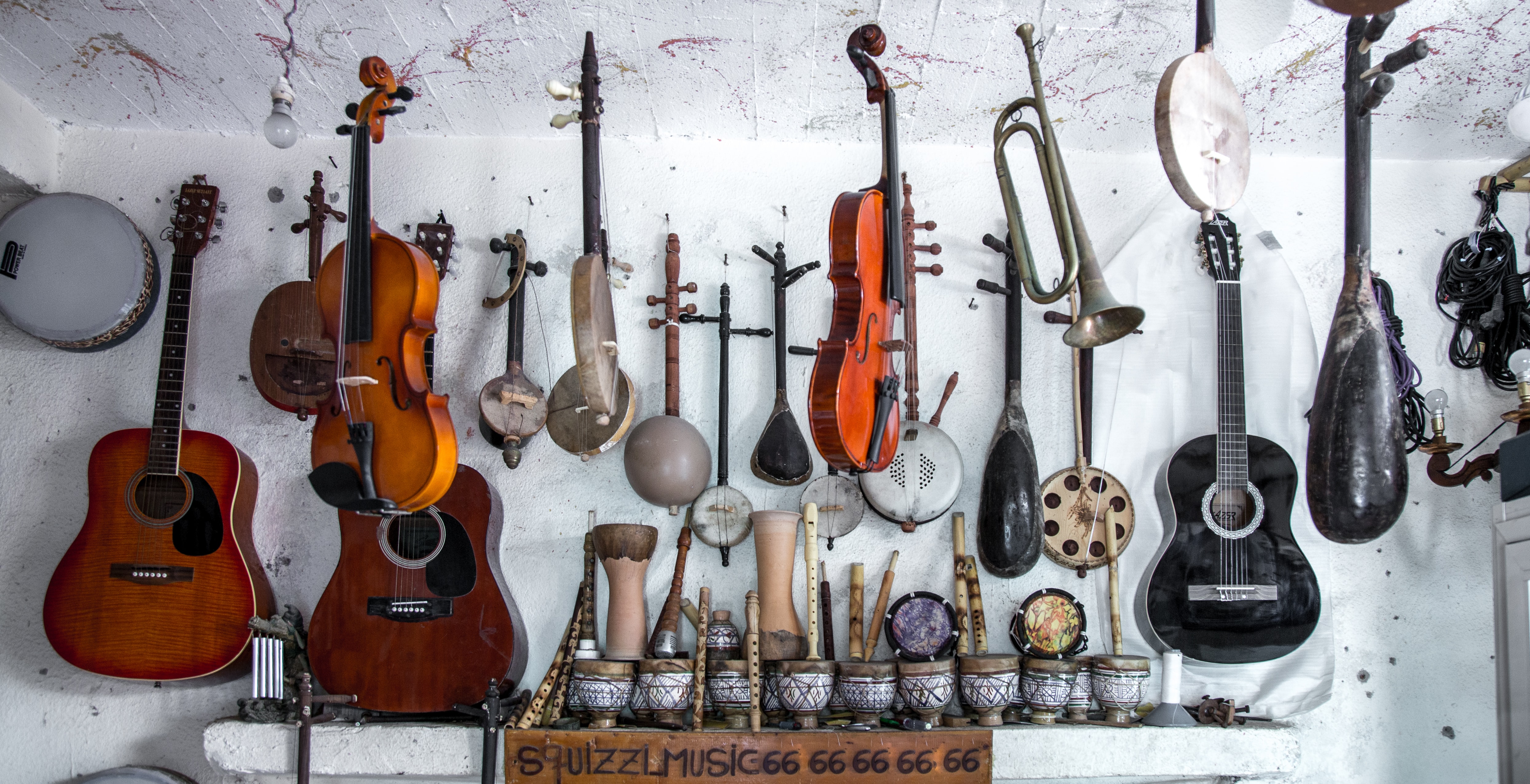
Photo by Karim MANJRA on Unsplash

Most 'how to...' 'synthesizer' articles talk about how to create 'classic' synthesizer sounds, and Gordon Reid's magnum opus 'Synth Secrets' series (in Sound On Sound) covers that in a lot of depth: 

https://www.soundonsound.com/series/synth-secrets-sound-sound 

There are quite a few articles in the series that talk about creating realistic sounds (wind, brass, strings, drums, etc.), often used as an illustration of the uses of specific synthesis techniques. (There are also various books from the end of the 20th Century, assembled from 'Electronic Musician' articles from Jim Aikin, Marc Vail, Craig Anderton et al covering much the same material, again with some coverage of imitative techniques, but I can't recall a specific 'imitative' series... So, my short answer is that I don't know of the 'definitive' answer - but that doesn't mean it doesn't exist!)

https://synthandsoftware.com/author/jimaikin/ (Bio of Jim Aikin)

https://jimaikin.net/ (Jim Aikin's web-site)

http://www.markvail.com/ (Marc Vail's web-site)

https://craiganderton.org/ (Craig Anderton's web-site)

(It is quite interesting to see how a previous generation of 'people who reviewed and wrote about synthesizers' is represented by magazine articles, reviews, books and web-sites, whereas the current  Loopop, Benn Jordan, Starsky Carr, etc. generation are all very active on YouTube...)

You can see this non-specific-ness about imitative synthesis in my 'Practically FM' series (in Sound On Sound magazine many decades ago), which kind of works towards 'imitative', but it tends to show more about how FM can produce synthesised, only-slightly 'imitative' sounds: 

http://www.muzines.co.uk/articles/practically-fm/3527

For techniques where 'imitative' is baked in, then people seem to resort to analogies. This article on Physical modelling quotes me here and there: 

https://theproaudiofiles.com/physical-modeling-synthesis/ 

Which leads to my take on physical modelling: 

https://www.soundonsound.com/techniques/physical-modelling-synthesis-explained 

This is again more about the modelling than the actual synthesis. One very good pointer to the problems of modelling is Yamaha's percussive physical modelling (Karplus-Strong et al) VP-1 synthesizer from 1994 that never made it from prototype to real world - there's an amazing prototype in the Yamaha 'Innovation Road - History of Products' museum in Hamamatsu, Japan... 

https://www.youtube.com/watch?v=3ZXk0pe6KUU

Technics made an amazing physical modelling synth in the mid 90s that you've probably never heard of... (The SX-WSA1 - I reviewed it for Sound On Sound, Mike Metlay reviewed it for the Computer Music Journal)

https://www.soundonsound.com/reviews/technics-sx-wsa1 (my review)

https://www.soundonsound.com/reviews/technics-sx-wsa1r (how to miss a bargain)

https://www.jstor.org/stable/3680833 (From the CMJ - behind a paywall)

(Modern VSTs that use modelling for pianos have seen better success in this space - as with much of technology, timing is vital: too early and the tech/knowledge isn't up to it, too late and the tech/knowledge is available to all... Feel free to do a Google search on 'Piano VST physical modelling'...) 

What is harder to find information on are the more formal, academic, methods. One example would be Residual Synthesis (aka Analysis/Synthesis or A/S), which takes the sound that you want to imitate, and subtracts it from a close imitation to give a 'residual' - the difference between the wanted sound and the synthesized version. That residual is then used as the starting point for a second imitation, and this continues iteratively until you have as close an approximation as you want. The trap here is that it can be very difficult to cope with the changes in timbre from dynamic playing, and it is easy to get bogged down in deconvolution problems that diverge, so there may not be an easy way to create all of the different residuals for different velocities. It's a bit like curve fitting: choose the wrong type of curve and you may be able to fit some of the data, but if you get new data, then you may find that the curve can't be persuaded to fit at all! I did an AES paper on a variant of residual synthesis back in 2018....

https://secure.aes.org/forum/pubs/conferences/?elib=19369 (The AES paywall this time...)

The 'elephant in the room', in my opinion, is that there's an easy escape route, and it started when synthesisers and samplers began to converge with instruments like the Roland D-50: suddenly you had something that produced sounds from hybrid sources: samples (often alarmingly short!) where you needed that characteristic 'fingerprint' for a specific type of sound; and synthesis for when you wanted to augment, enhance, accompany, sustain or alter the sound so that it had a mixture of realistic and synthetic. S&S instruments used these 'Sample & Synthesis' techniques to give huge numbers of presets that passed the 'Mom' test (Would your Mom say that it sounded like what the preset was called?), and layered variations or synthesised sounds on top to give variations. Depending on your viewpoint, these are either hyper-real, or sub-real, but they were easy to produce, and the end of the 20th Century saw huge numbers of boxes with large numbers of presets and lots of sample ROM inside them.

Roland D-50 (My review)

Interview with Ikutaro Kakehashi (My Interview with the head of Roland) 

You can seen how appealing the S&S technique is by considering the E-Mu Proteus, which started out as an enormously successful 'orchestra in a box' (probably one in just about every studio at one time), but which gradually morphed (samples and filters!) over time into providing lots of samples of synthetic sounds, on ROM cards that could be put into slots to create boxes containing vast numbers of sounds (My E-Mu PX7 has all four slots full of 32MB ROMs, for example). 

A quick timeline of E-Mu 1U rack-mounting sample players...

A table of the 32MB ROMs would follow a similar timeline, although not all ROMs got a dedicated player... 

https://www.soundonsound.com/music-business/30-years-emu (E-Mu History)

Yamaha's S&S synthesisers (the current Montage, for example), uses lots of samples to imitate sounds (often layering several variations, and using different samples for different dynamics), but at the same time, has a very powerful FM synthesizer inside which can be used to imitate, augment and enhance the samples. What do you hear a lot of the time from a 'factory/stock' Montage? Samples augmented by other samples... and by FM...

https://europe.yamaha.com/en/products/music_production/synthesizers/montage/features.html

(This is more of an observation about the way that synthesizers are 'voiced' nowadays, and is not a criticism! I really love my Montage 7, and have made quite a few FM patches - a few of which are on SoundMondo...)

Turning synthesis around, and writing a series of articles that start with imitative techniques, is a big task (requiring lots of time, lots of research, and lots of painstaking skill and effort), and the 'Mom' test is fighting you all the way, because S&S instruments (I would count a lot of sample replay devices and sample libraries as being in that set) pass easily, and rather like the 'Uncanny Valley' in making CGI people, it only needs one minor inconsistency for your brain/ears to detect the synthetic nature, and you are back to square one (a 'football commentary on radio' reference, it turns out!)... Getting a real trombone player to listen to a few 'brass' sample libraries can be very illuminating...

https://en.wikipedia.org/wiki/Uncanny_valley (The 'Uncanny Valley'...)

So, you now have a partial view of what I have been doing in electronic music from the early 1970s to the present... This is all my biased, personal opinion based on how I lived through those times. Your opinion can differ, of course...

The 'Mom' Test

Easy! Just ask someone considerably older (wiser, more travelled, more experienced, maybe someone who listens to more Jazz or Classical music...) than yourself to listen to a sound made by your synthesizer, VST, etc. Then ask them what the sound was. If it was called 'PanFlute47b' and they say: 'It is a flute!', then you pass the test. If they say: 'It sounds kind of like a flute type of thing...', then you get a partial pass. If they say: 'Is this another of your synthesizery sounds?', then you fail. 

---

If you find my writing helpful, informative or entertaining, then please consider visiting this link:

Synthesizerwriter's Store (New 'Modular thinking' designs now available!)

Buy me a coffeeBuy me a coffee (Encourage me to write more posts like this one!)... or...

Buy Me a Coffee at ko-fi.com (Encourage me via a different route entirely...)

Or just tell someone else that there's this amazing blog about hi-tech music...


Friday, 1 October 2021

Behind the scenes of the 'Straight Maths' Virtual Instrument on Pianobook.co.uk

I have been exploring the possibilities of mis-using a sample player recently. Dave Hilowitz's excellent 'Decent Sampler' is, imho, not only much better than merely 'decent', but it has also allowed me to go slightly outside the usual territory of samples and to become an intrepid explorer. Huge thanks also to the team behind Pianobook.co.uk - a great contribution to the world of sampling, created by Christian Henson.

So here is a quick recap of the design thinking behind two of my recent releases on Pianobook.co.uk.

Parallel Inversions

'Parallel Inversions' was my first really developed idea that isn't just a sample replay. It deliberately breaks the rules to produce an 'alien' instrument. In a 5 star review, Michael Milburn said; 

'I don’t understand what these are, but do enjoy the sounds.'

The user interface is the first thing that hits people with this virtual instrument. The top row of controls has 23 vertical faders that look a bit like the 'Mic' sliders that you see in many sample players - except that instead of 2 or 3, or maybe 5, or (extreme) 7 or higher, there are almost two dozen of them! They are split into four sections, and there are some subtleties in the way that these are put together.

The most important section is the one that has the 0 to 4 'Mic' sliders in it. The 'Zero' slider is set at about 75% in the default preset, so that you know it is important. This slider plays the 'fundamental' frequency that is played by Decent Sampler, or rather, it plays that frequency sometimes - the XML code that Decent Sampler uses to specify how samples are played allow all sorts of manipulations, and I'm exploiting this here. So the 'Zero' / '0' slider plays three different octaves, using a random 'Round Robin' assignment. So if you play a C3, then you will actually get a C3, or a C4, or a C5. The ratios are set asymmetrically, with the 'octave down' option half the probability of the others. So for every chord that you play, you may get that chord, or you may get a biased inversion of it instead (a 'bass-light' inversion). This isn't how many instruments work! (But it is an 'alien' instrument...)

The 1 to 4 Mic sliders are actually pitched in semitones up from the 0 (zero), which is why they are arranged in the staggered 'piano keyboard' arrangement. This is immediately obvious if you increase the '1' slider, because you get a C / C# discord! So the 0 to 4 section controls parallel pitches, which (again) isn't how many conventional instruments work - organ drawbars are a bit like this, but...).

The next section to the right is from 5 to 11, and again these are parallel semitones up from the 0 (zero) pitch. The '5' (fifth) slider is set at about 75% in the default preset so that you know it is important (just as with the 0 (zero) slider. So the default preset plays two sine waves, a firth apart, and in both cases, the pitches are inverted (or not) at random, with a preference for one octave up instead of down. All of the inverted pitches are slightly detuned relative to the fundamental pitch, which gives a more interesting tone. All of these 'Parallel & Inverted' sliders are centred in the stereo image.

The combination of fixed parallel intervals (the default 5th is just intended as a hint to get you started) and random inversions kind of breaks 'the rules', and gives this instrument an interesting and unusual character. Have fun breaking all those conventions that you are supposed to follow, and embrace performances that are never the same twice!  

On the far left, there is a single '-12' slider, which was supposed to play a pitch one octave down from the fundamental. Unfortunately, I'm not the world's greatest programmer, and so it actually plays the same pitch as the '0' (zero) slider, except that the random inversions mean that most of the time it plays a different octave. Although Parallel inversions has had 3 versions, I have left this defect in there, because serendipitously, it sounds good. 

The A to K sliders are different again. This time they are panned either hard left or hard right, and they are distorted sine waves, instead of the purity of 0 to 11 and -12. So the A to K sliders add timbre and broaden the stereo image. Again, this isn't how normal instruments tend to work, but...

Finally, the lower row has more 'synthesizer'-type controls than is normal, with a full ADSR 'envelope' control, and I recommend the 'Attack' control for giving gravitas, and the 'Decay' control (with 'Sustain' set to near zero) for adding a 'Radiophonic' or synthetic character that sounds like it is from the 1970s. 

Straight Maths

'Straight Maths' has a busy user interface, but it extends some of the ideas in Parallel Inversions. The left hand side has 48 'Mic' sliders (yep, a lot!), whilst the right hand side has the extended 'synthesizer' controls, but in a more compact vertical format.

The three rows on the left are devoted to three different types of sound source. 

S - Top Row - additive synthesis

The top row (S) is sine waves (with twists) to provide simple Fourier additive synthesis. The '0' (zero) slider is again set as a hint that it is the fundamental in the default preset, but it does tend to get lost with all the other sliders! 

The three blocks of four Mic sliders on the top row have, from left to right:

- a Sine wave (0, 1 or 2 octaves up, shown as 0, 1 or 2), panned to the centre,

- a hollow-sounding, slightly square waveform (-), panned to the centre,

- a slightly bright, slightly sawtooth'y waveform (N (get it?)), panned to the centre, and 

- a detuned stereo 'sweetener' sine waveform (s) that adds a bit of interest and broadens the stereo image. If you want, you can ignore the 's' sliders and add your own preferred chorus effect via VST or outboard...

Yes, there's a bug with the 'S' in the two octaves up section, but that's part of the charm of the user interface, and does not affect the tone! 

The '-2' and '-1' mic sliders are sub-octave sine waves that can add low end to sounds. Use with care! 

As with all additive synthesizers, you mix and match the sliders to give you the combination of harmonics that you want, and then use the ADSR controls to give the sound a bit of shape in time. 

M - Middle Row - Karplus-Strong physical modelling

The second row has 16 different samples of metallic-sounding decaying sounds, derived from the Karplus-Strong hammered/plucked string physical model. '13' is my personal favourite, but it is way too strident for most purposes, and so just the merest hint of it is usually plenty! I resisted the temptation to arrange the sliders in any sort of order (previously I tried a 'tone-to-noise' arrangement), mainly because when I have tried to do this, I have rediscovered just how difficult it is to arrange multi-dimensional differences into a linear order. So I'm afraid that you will just need to play with the sliders until you get used to the sounds. Oh, and 10 and 11 ARE different, but not as different as I wanted! 

The 16 sliders are all tuned slightly differently, and are all stereo. This means that you can use combinations to add harmonics and detuning

My preference is to use the middle row to add a little bit of metallic 'bite' to sounds that are mainly top-row additive at their core. You can completely ignore this and do your own thing, of course!

W- Lower Row - Risset physical modelling

This row mis-uses Risset's work on synthesizing drum sounds, and adapts it to producing 'woody' sounding fast-decaying thumps and clunks to add percussive starts to the higher row sounds. There are four sets of sounds, arranged with the left-most sound in each set being the thickest (three sounds at once) and the others just single sounds. The detuning is toned back for most of these samples. These sounds are in mono, centered in the stereo image. I did play with stereo samples, but at low frequencies there isn't much to gain. To show how self-contradictory I can be, my '9126 Sawtooths' instrument on Pianobook.co.uk has way too much stereo bass!

It is quite fascinating how just a brief 'blip' of woodiness at the start of a sound that is all sine waves can totally change the character and timbre that you perceive. (Oh, and too much reverb is always a good idea!) This low row is influenced by the clicks found in old tone-wheel organs (the idea of adding percussive starts is not 'new' in any way!) and by the rather novel use of samples of the starts of instruments that Roland used in their D-50 synthesizer to augment a simpler digital synthesis technique for the sustained sounds. Roland called this mix of samples and synthesis 'Linear Arithmetic', so 'Straight Maths' is my way of paying homage to a classic 'personal favourite' synthesizer from the 80s. Okay, so now you know where the name comes from!

As before, the lowest row is used to add a little extra bit of character to the sound. The default preset  deliberately adds too much 'W' so that your first experience of 'Straight Maths' is 'Wow!'. Maybe that what the 'W' really stands for? But remember that subtlety is often the best approach, and too much 'W' may take you into cheesy territory...

Trivia

The rows were going to be labelled as: J, AK and C, for Joseph, Alexander, Kevin and Claude, but I thought this might be too obscure. What is interesting is that you now know a famous 'Kevin' - although Karplus still sounds uber-cool to me!

Letiti gave 'Straight Maths' a 5 star review, which is much appreciated, including this comment:

'One of the most innovative and unusual Pianobook entries'

For which I am enormously grateful!

---

If you find my writing helpful, informative or entertaining, then please consider visiting this link:


Synthesizerwriter's Store (New 'Modular thinking' designs now available!)

Buy me a coffeeBuy me a coffee (Encourage me to write more posts like this one!)